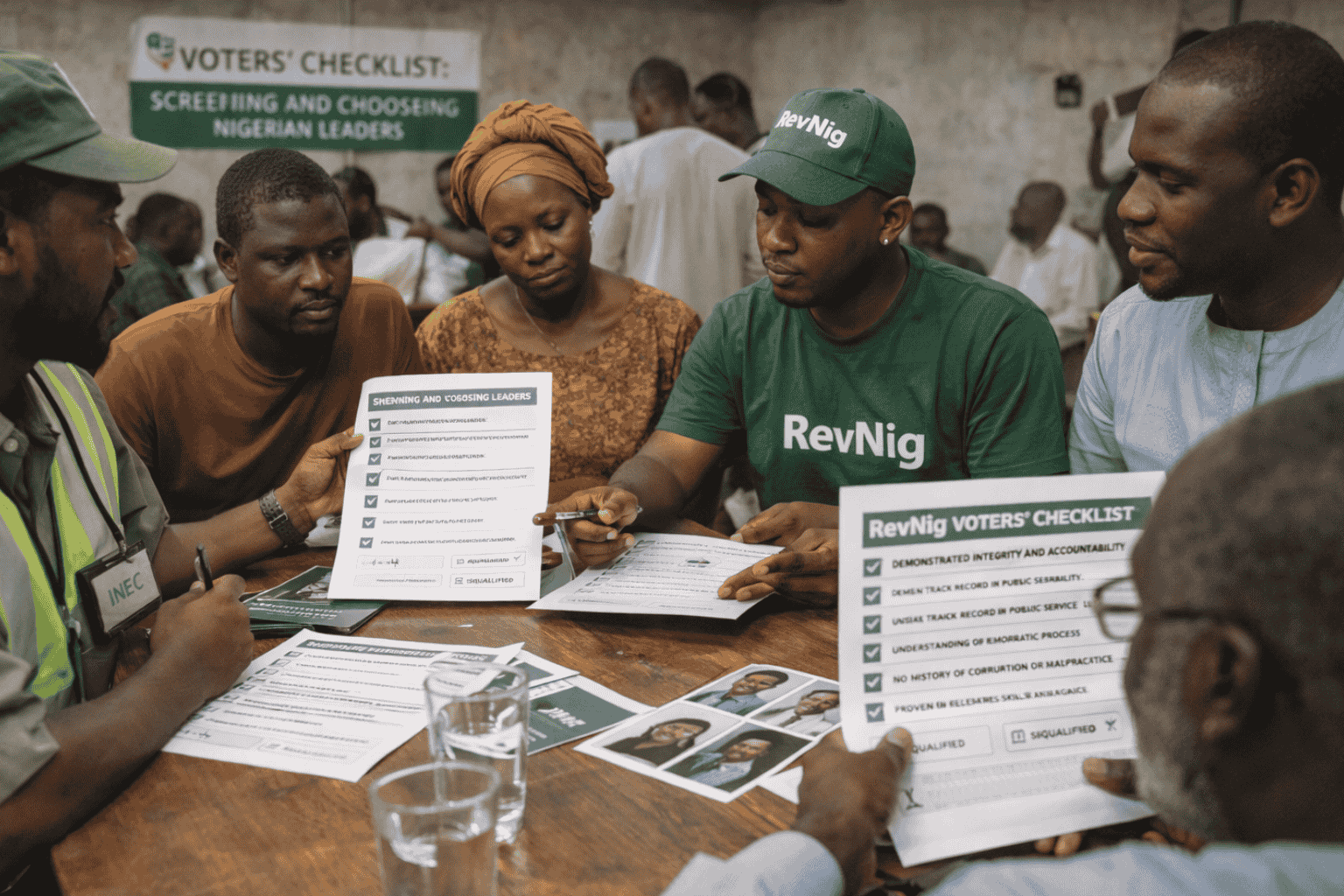
How Ordinary Nigerians Turn Democratic Power into National Results
Fellow Nigerians,
Plan B strengthened electoral integrity and the democratic process.
Plan C established the framework for identifying and promoting credible leadership.
This page answers the most practical democratic question of all:
How does an ordinary Nigerian apply these standards when it truly matters?
At the polling unit.
Under pressure.
With real candidates.
And with the future of the nation at stake.
Because democracy succeeds only when citizens learn to evaluate leadership seriously.
The First Rule: You Are the Employer
Politicians are not saviours.
They are applicants for public responsibility.
Democracy means:
- citizens interview,
- citizens verify,
- and citizens decide.
If you would not hand over your business, savings, or family future to an unqualified stranger, you should not hand over Nigeria carelessly either.
This checklist exists to help Nigerians:
- screen leadership rationally,
- reduce emotional manipulation,
- and make disciplined democratic choices.
“The ballot is not a gesture of emotion. It is a hiring decision with national consequences.”
The RevNig Leadership Screening Checklist
STEP 1 — The Transparency Test
Before supporting any candidate, ask:
Can Nigerians verify:
- educational background?
- professional history?
- health readiness?
- policy positions?
- public accountability commitments?
Candidates unwilling to provide basic transparency weaken public trust immediately.
Because leaders who hide critical information before elections often continue hiding important decisions after elections.
Transparency must come before power.
STEP 2 — The Accountability Test
Ask clearly:
Is the candidate willing to:
- answer public questions,
- submit to scrutiny,
- accept performance evaluation,
- and support democratic accountability mechanisms?
Leadership without accountability eventually becomes vulnerable to abuse.
A credible leader should never fear lawful public scrutiny.
“A leader uncomfortable with accountability before office becomes even less accountable after gaining power.”
STEP 3 — The Competence Test
Ignore:
- slogans,
- crowd noise,
- emotional speeches,
- and party songs.
Focus instead on practical governance ability.
Ask:
- Does the candidate understand Nigeria’s core challenges?
- Are proposed solutions realistic and measurable?
- Can the candidate explain implementation clearly?
- Does the vision extend beyond campaign rhetoric?
Charisma without competence has repeatedly damaged nations.
Nigeria needs leadership capable of building systems — not merely performing politics.
STEP 4 — The Economic Discipline Test
Observe the candidate’s attitude toward:
- public spending,
- governance costs,
- corruption reduction,
- and financial responsibility.
Ask:
- Does the candidate support reducing waste?
- Is there seriousness about cutting excessive government luxury?
- Does the candidate understand economic discipline?
- Are anti-corruption commitments practical or merely symbolic?
A leader comfortable with waste eventually becomes comfortable with corruption.
STEP 5 — The Shared Reality Test
Ask an important democratic question:
Does this leader understand the realities ordinary Nigerians experience daily?
Credible leadership should remain connected to:
- local institutions,
- public infrastructure,
- healthcare realities,
- educational systems,
- and the economic pressures facing citizens.
Leaders completely insulated from national realities often lack urgency to solve them.
STEP 6 — The Independence Test
Observe carefully:
Who truly controls the candidate?
Ask:
- Is the candidate financially dependent on political godfathers?
- Does the campaign appear captured by private interests?
- Will loyalty belong to citizens or hidden sponsors?
A candidate financially owned before elections becomes politically compromised after elections.
Democracy weakens when leadership becomes indebted to private power instead of public trust.
STEP 7 — The Anti-Corruption Test
Demand clarity on:
- electoral reform,
- public transparency,
- institutional accountability,
- and technology-driven governance oversight.
Be cautious when candidates:
- avoid specifics,
- rely entirely on vague slogans,
- or speak emotionally without measurable commitments.
Ambiguity often protects corruption.
“Citizens should never reward leaders who remain intentionally unclear about accountability.”
STEP 8 — Compare Before Deciding
Do not evaluate candidates emotionally or in isolation.
Instead:
- compare positions carefully,
- examine records objectively,
- and assess consistency across all standards.
This helps:
- reduce tribal bias,
- weaken propaganda,
- and encourage rational democratic judgement.
Democracy improves when citizens compare leadership seriously rather than follow political sentiment blindly.
STEP 9 — Election-Day Discipline
Responsible democratic participation requires more than simply casting a ballot.
Citizens should:
- vote peacefully,
- remain vigilant,
- reject inducement,
- observe transparently,
- and support lawful electoral accountability.
Democratic participation requires both:
- discipline,
- and responsibility.
STEP 10 — Post-Election Accountability
Elections are not the end of citizenship.
After leaders assume office:
- promises should be tracked,
- performance should be evaluated,
- and accountability should continue.
Democracy weakens when voters disappear immediately after elections.
“A vote without follow-up eventually becomes permission for failure.”
How This Checklist Strengthens Nigeria
When citizens screen leadership carefully:
- corruption becomes harder,
- manipulation weakens,
- institutions improve,
- and governance quality rises.
Disciplined democratic choices strengthen:
- economic confidence,
- institutional stability,
- public trust,
- and national development.
Leadership quality ultimately shapes national outcomes.
From Voting to Democratic Responsibility
From emotional voting → to disciplined judgement
From blind loyalty → to accountable leadership
From political gambling → to democratic responsibility
Yes We Will.
A Final Instruction to Nigerians
Fellow Nigerians,
Do not ask only:
“Who should we vote for?”
Ask instead:
“Who has earned our democratic trust?”
Judge every candidate by the same standards:
- Competence over slogans,
- Integrity over sentiment,
- Accountability over propaganda,
- Public interest over personal or sectional loyalty.
Then make your democratic choice responsibly.
Because the quality of leadership Nigeria receives depends, in part, on the standards citizens demand before granting public trust.
Vote like Nigeria’s future depends on it.
Because it does.
Completing Plan C
This checklist brings Plan C to its practical conclusion: credible leadership requires both credible candidates and citizens prepared to evaluate them carefully.
RevNig’s leadership framework therefore moves from identifying the qualities Nigeria needs in its leaders to applying those standards when democratic choices are made.
Continue Reading
A political movement becomes meaningful when it begins improving lives directly within communities — not only during elections, but every day.
A protected democracy must ultimately improve the daily lives of citizens directly through practical development, self-help initiatives, and community empowerment.
Next:
Plan D: The People’s Capital: How Millions Can Fund Nigeria’s Transformation