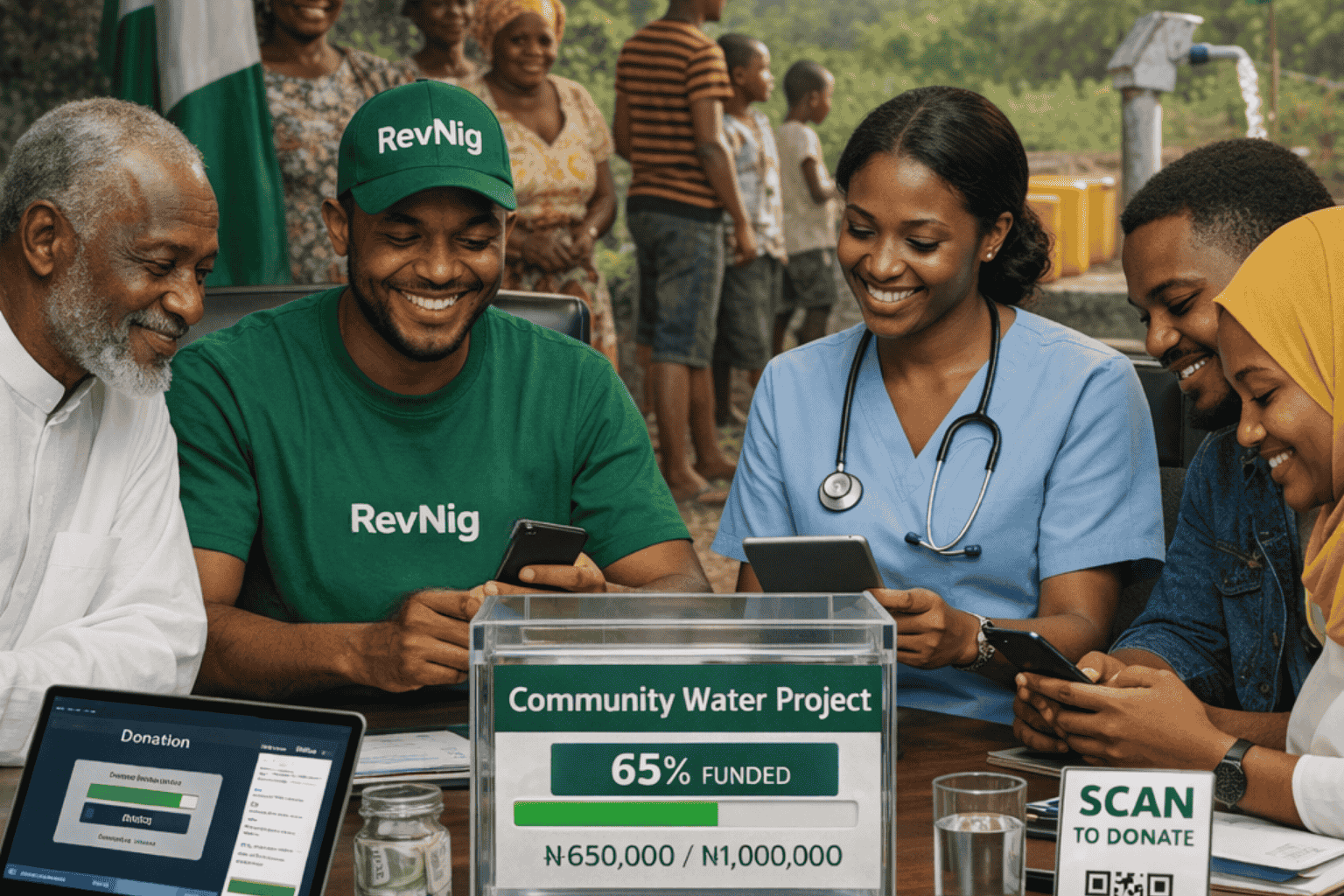
Plan D2
Proof That Collective Action Works
Fellow Nigerians,
Plan D2 is where organised participation becomes visible community development.
RevNig believes that Nigerians possess not only the collective capacity to identify their communities’ most pressing needs, but also the ability to select trustworthy individuals to help address them.
As RevNig builds its membership, Plan D2 will establish a democratic framework through which members can propose development projects, participate in online polls and voting, and select people of proven integrity to coordinate approved initiatives.
These individuals will be nominated and chosen by members through transparent procedures, rather than appointed solely because of wealth, political influence or personal connections.
Where appropriate, approved projects and their contributions will be managed directly by the selected individuals or project committees, subject to established financial safeguards, public reporting and accountability requirements.
RevNig will provide the organisational framework, while members will participate directly in deciding what projects deserve support and who will be entrusted with delivering them.
Plan D2 exists to answer one important national question:
What can millions of organised Nigerians accomplish when they collectively choose their priorities, select accountable project leaders and contribute voluntarily towards practical development?
The objective is clear:
To transform collective participation into transparent, measurable and community-driven progress.
What Plan D2 Is — and What It Is Not
Plan D2 is:
- Community-focused,
- Needs-driven,
- Transparent by design,
- Measurable,
- And complementary to responsible government.
It is built around:
- Practical solutions,
- Local participation,
- And visible public benefit.
Plan D2 Is Not:
- Political patronage,
- Charity theatre,
- Endless fundraising,
- Elite-controlled development,
- Or a replacement for government responsibility.
This is structured civic development powered by accountability.
Not symbolism.
The Core Principle: Small Contributions, Visible Results
Plan D2 operates on one simple democratic truth:
When citizens trust systems, participation increases.
And when participation increases, impact multiplies.
The model is straightforward:
- Many contributors,
- Small voluntary contributions,
- Clearly defined projects,
- Public progress reporting,
- And transparent completion verification.
Trust grows when results become visible repeatedly.
“Communities regain confidence when citizens can physically see where contributions go and what they achieve.”
The Collective Power of 20 Million Members
RevNig’s ambition to organise more than 20 million Nigerians is not limited to democratic participation. It also creates the potential for a remarkable system of community-driven development.
Imagine millions of members voluntarily contributing just ₦1,000 monthly, or a comparable modest amount from Nigerians living abroad, towards projects chosen by the members themselves.
No member will be compelled to contribute. Participation will remain entirely voluntary.
Yet the collective financial potential is enormous.
If five million members — just one-quarter of RevNig’s target membership — contribute ₦1,000 monthly, their combined contributions will amount to ₦5 billion every month.
Over twelve months, that represents ₦60 billion.
If ten million members participate consistently, the annual total will reach ₦120 billion.
And if all 20 million members voluntarily contribute the same amount, the mathematical potential will reach ₦240 billion annually.
These are illustrations of collective financial capacity, not guaranteed fundraising outcomes.
Small individual contributions. Enormous collective potential. Visible community development.
Through Plan D2, RevNig will establish a framework in which members can:
- Identify community development needs,
- Nominate projects for consideration,
- Choose eligible projects through transparent online polling and voting,
- Nominate and elect trusted individuals to manage approved projects,
- Contribute voluntarily through approved project-specific financial channels,
- And monitor implementation, expenditure and results.
The individuals entrusted with managing projects will be selected through members’ votes and must satisfy established standards of integrity, competence and accountability.
Where appropriate, these elected project leaders or committees will manage contributions directly through legally compliant financial arrangements, without RevNig necessarily receiving or controlling the funds.
Every approved project must have a clear budget, identifiable management, financial safeguards and transparent reporting arrangements.
RevNig will organise the people. Members will choose the projects. Trusted individuals will manage implementation. Accountability will protect the contributions.
The objective is not merely to raise money.
It is to establish a lasting system through which organised Nigerians can collectively identify problems, finance practical solutions and verify the results.
Twenty million organised Nigerians can become a powerful foundation for people-driven national development.
What Community Crowdfunding Can Achieve
The following examples are realistic illustrations designed to show what organised participation can accomplish over time.
1. Community Water Projects
Many Nigerian communities still lack reliable access to clean water.
Plan D2 can support:
- Boreholes,
- Water access systems,
- And sustainable local water solutions.
For example:
- Modest contributions from large numbers of organised citizens can collectively finance multiple community water projects annually.
The impact includes:
- Reduced waterborne disease,
- Improved health outcomes,
- And better quality of life for women and children.
This is not theory.
It is logistics supported by transparency.
2. Primary Healthcare Support
Not every community requires massive medical infrastructure immediately.
Many communities simply need:
- Functional clinics,
- Essential equipment,
- Reliable power supply,
- And basic healthcare support.
Plan D2 may help support:
- Clinic upgrades,
- Solar-powered medical storage,
- Essential diagnostic equipment,
- And community healthcare access improvements.
Visible healthcare improvements restore public trust quickly because citizens experience the results directly.
3. Education and Learning Infrastructure
Plan D2 prioritises foundational education because:
Nations rise or decline through the quality of their educational systems.
Potential support areas include:
- Classroom rehabilitation,
- Desks and learning materials,
- Sanitation facilities,
- Solar lighting,
- Libraries,
- And community learning spaces.
Even modest improvements can positively affect thousands of students over time.
Educational investment compounds across generations.
4. Agriculture and Food Security
Plan D2 also supports practical initiatives capable of strengthening:
- Local food production,
- Agricultural efficiency,
- And community resilience.
This may include:
- Cooperative farming support,
- Irrigation assistance,
- Agricultural training,
- And locally sustainable food systems.
Food security strengthens both:
- Economic stability,
- And social stability.
5. Local Innovation and Technology
Communities also contain:
- Inventors,
- Developers,
- Educators,
- And problem-solvers capable of creating scalable local solutions.
Plan D2 encourages projects that:
- Solve practical community problems,
- Improve productivity,
- And generate measurable social benefit.
Because national transformation also depends on innovation emerging from ordinary Nigerians.
How Members Will Choose Community Projects
Plan D2 will place members at the centre of community project selection.
Projects will not be imposed solely by RevNig’s leadership or by influential individuals.
Members will have opportunities to identify community needs, submit project proposals and participate in transparent online polls or voting.
The selection process will follow five stages:
1. Project Nomination
Members will submit proposals identifying practical needs within their communities.
Each proposal must explain:
- The problem to be addressed,
- The community or population that will benefit,
- The estimated cost,
- The expected public benefit,
- And the arrangements needed for implementation and maintenance.
2. Preliminary Assessment
Proposals will undergo feasibility, financial, legal and public-interest checks before being presented for voting.
Projects that fail essential eligibility or safeguarding requirements will not proceed to funding.
3. Members’ Online Voting
Eligible members will participate in online polls or voting to determine which qualified projects receive priority.
RevNig will establish procedures to promote fair participation, prevent duplicate voting and publish the results transparently.
4. Approval and Fundraising
Projects selected through the approved voting process will proceed to detailed budgeting, verification and appropriate fundraising arrangements.
Contributions will remain voluntary.
5. Implementation and Public Reporting
Approved projects will proceed under accountable management arrangements, with published progress reports, financial records and completion assessments.
Members will help determine what gets built, while transparent procedures will establish how it is delivered.
The Trust Architecture of Plan D2
RevNig understands that trust is everything.
That is why Plan D2 operates under strict accountability principles.
1. Member-Elected Project Leadership
Plan D2 will entrust community projects to individuals selected through transparent member nomination and voting procedures.
RevNig will encourage the nomination of people recognised for their:
- Integrity,
- Honesty,
- Relevant experience,
- Commitment to public service,
- Financial responsibility,
- And willingness to submit to scrutiny.
Nominees must satisfy established eligibility and verification requirements before participating in project leadership elections.
Members will vote to select the individuals or committees responsible for coordinating approved projects.
Where legally and operationally appropriate, these elected project leaders will manage implementation and project-specific contributions directly through approved financial arrangements.
They must:
- Maintain accurate financial records,
- Publish appropriate income and expenditure reports,
- Disclose conflicts of interest,
- Provide evidence of project progress,
- Cooperate with independent financial review where required,
- And remain accountable to members and contributors.
RevNig will establish procedures for investigating complaints, addressing misconduct and replacing project leaders who fail to meet their responsibilities.
No project leader will possess an automatic or permanent right to control community contributions.
Leadership will be entrusted through members’ confidence and maintained through demonstrated accountability.
2. Transparent Project Funding and Reporting
Plan D2 will establish clear financial safeguards for every project approved through members’ online voting.
Where project contributions are managed directly by elected individuals or committees, the funds must be received through properly established and legally compliant project-specific accounts or other approved financial arrangements.
Project leaders must not treat community contributions as personal income or unrestricted private funds.
Before fundraising begins, every approved project must disclose:
- The project’s purpose and location,
- The approved budget and funding target,
- The identities and responsibilities of its elected managers,
- The authorised financial receiving arrangements,
- The proposed implementation timetable,
- The arrangements for monitoring expenditure,
- And the procedures for addressing delays, cancellation or unused funds.
Contributors will be informed whether their donations are restricted to a particular project or allocated to a clearly identified group of approved projects.
Project managers will be required to maintain proper financial records and provide periodic reports showing:
- Total contributions received,
- Expenditure incurred,
- Progress against approved milestones,
- Outstanding financial commitments,
- And the remaining project balance.
No individual will receive unrestricted control over community funds merely because they have won an online election.
RevNig will establish financial safeguards, including appropriate authorisation procedures, verification and independent review arrangements before project fundraising begins.
Every contribution must have a clear purpose. Every expenditure must be accountable. Every completed project must be verifiable.
3. Independent Verification and Accountability
Member-elected project leadership will operate under continuing accountability.
RevNig will establish procedures for verifying project progress, reviewing financial reports and addressing concerns raised by members, contributors and beneficiary communities.
These procedures will include:
- Published project milestones,
- Evidence of expenditure and delivery,
- Appropriate independent verification,
- Accessible complaints and reporting channels,
- Conflict-of-interest safeguards,
- And procedures for suspending or replacing project managers where serious misconduct is established.
Project managers must cooperate with lawful scrutiny and provide the information required under the approved accountability framework.
Where financial irregularities are identified, appropriate corrective action will be taken, including referral to relevant authorities when warranted.
Members will have a defined role in reviewing project performance and holding elected project leaders accountable.
Those entrusted with community resources must remain answerable to the people whose confidence placed them in that position.
Trust will earn responsibility. Transparency will sustain it. Accountability will protect it.
Why Plan D2 Strengthens Democracy
Plan D2 does more than support community development.
It creates opportunities for RevNig members to practise democratic decision-making beyond national, state and local government elections.
Through transparent online polling and voting, members will participate in:
- Identifying community needs,
- Selecting projects that deserve priority,
- Nominating and electing trusted project leaders,
- Reviewing financial and implementation reports,
- And holding those entrusted with community resources accountable.
This approach connects democratic participation with practical responsibility.
Members will not simply contribute money and wait for results. They will have opportunities to participate in deciding how approved projects are selected, who manages them and how their performance is assessed.
When communities experience transparent budgeting, responsible financial management and verifiable project delivery, they can develop stronger expectations of accountability in public institutions.
Plan D2 will therefore pursue two complementary objectives:
Community development through organised collective action.
Democratic participation through transparent decision-making and accountability.
The long-term objective is to strengthen a culture in which leadership is entrusted through fair procedures, public resources are managed responsibly and citizens remain actively involved in decisions affecting their communities.
How Plan D2 Fits the RevNig Framework
Plan D2 connects community development with the four pillars of RevNig’s democratic and national transformation framework.
Plan A
Mobilises and organises Nigerians to exercise their democratic power collectively.
Plan B
Strengthens electoral integrity and protects the democratic process.
Plan C
Promotes credible leadership and establishes standards for evaluating those entrusted with public responsibility.
Plan D
Transforms organised civic participation into sustainable democratic support, practical development and measurable public benefit.
Plan D2 applies these principles to community development by enabling members to choose projects, elect accountable project leaders and participate in monitoring implementation.
RevNig’s ambition to organise more than 20 million members creates the potential for substantial collective participation.
Through modest, voluntary monthly contributions, participating members can help finance projects that have passed the established selection and approval processes.
The same principles of transparency, accountability and responsible leadership promoted throughout the RevNig framework will guide the management of these initiatives.
The sequence is clear:
We organise together.
We identify community needs together.
We choose projects and responsible leaders through transparent voting.
We contribute voluntarily towards approved initiatives.
We monitor implementation and hold project managers accountable.
We build together — and remain accountable for what we build.
This is how organised civic participation can contribute to lasting community development.
A Direct Call to Nigerians
Fellow Nigerians,
National transformation does not happen only in government offices.
It also happens in communities, through cooperation, responsible leadership and citizens willing to contribute towards practical solutions.
RevNig aims to organise more than 20 million Nigerians into a movement capable of combining democratic participation with community development.
Imagine what millions of organised Nigerians can accomplish when they voluntarily contribute just ₦1,000 monthly, or a comparable modest amount from abroad, towards properly approved community projects.
The potential is substantial.
But Plan D2 is not simply about collecting contributions.
It is about giving members a meaningful role in deciding what projects deserve support, who will manage them and how those entrusted with resources will be held accountable.
RevNig will establish a framework for:
- Transparent project nominations,
- Fair online polling and voting,
- Member-elected project leadership,
- Voluntary and accountable financial contributions,
- Public progress reporting,
- And independent verification of project outcomes.
Every project must serve a legitimate community need.
Every project leader must remain accountable.
Every contribution must be handled transparently.
And every completed project must be open to verification.
The power of 20 million organised Nigerians will lie not merely in their numbers, but in what they can accomplish together.
Yes We Will.
Continue Reading
Plan D2 demonstrates how organised citizens can select and support practical community development projects through transparent participation and accountable management.
Plan D3 extends this philosophy to innovation, enterprise development, employment opportunities and practical solutions that can strengthen Nigeria’s economic future.
Next: